
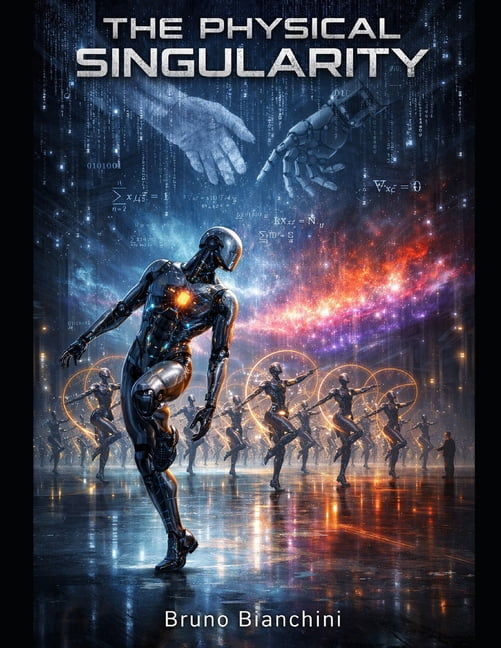
The Physical Singularity, (Paperback)
Product details
| Management number | 238716231 | Release Date | 2026/07/11 | List Price | US$11.99 | Model Number | 238716231 | ||
|---|---|---|---|---|---|---|---|---|---|
| Category | |||||||||
<i>The Physical Singularity: When Human Labor Becomes Mathematics - and Machines Inherit the Earth</i> is a provocative and deeply researched book about the coming replacement of human physical labor by intelligent machines. Rather than presenting science fiction fantasies, the author argues that this transformation is already underway and is driven by simple economic and thermodynamic realities.<br>The book's central thesis is that humanoid robots powered by modern AI systems will soon become cheaper, more efficient, and more scalable than human workers in almost every physical industry. Unlike earlier industrial revolutions, which replaced only specific tasks while creating new forms of employment, this new wave of automation threatens both physical and cognitive labor simultaneously.<br>The author begins by examining human labor through the lens of energy and biology. Human civilization, the book argues, has always depended on converting calories into work. Humans require food, sleep, healthcare, wages, and decades of development before becoming productive workers. Robots, by contrast, operate on electricity, do not tire, can work continuously, and improve through software updates. The economic comparison becomes stark: robotic labor is rapidly approaching costs measured in cents per hour.<br>A major focus of the book is the rise of Vision-Language-Action (VLA) models - AI systems capable of understanding visual environments, interpreting language commands, and controlling robotic bodies in real time. These models allow robots to move beyond repetitive factory automation into flexible, general-purpose work. The author explains how breakthroughs in world models, simulation training, reinforcement learning, and massive datasets have solved many of the challenges that once protected human labor.<br>The book also highlights the importance of China's manufacturing ecosystem. According to the author, China's dominance in electric vehicles, batteries, motors, and supply chains has dramatically reduced the cost of humanoid robots. What once cost tens of thousands of dollars is quickly becoming a commodity product, accelerating global adoption.<br>Another key idea is "fleet learning." Unlike humans, robots can instantly share knowledge across entire networks. When one robot learns a task or solves a problem, that information can be transmitted to every other robot using the same model. This creates a collective intelligence that improves exponentially with scale, giving machines a learning advantage humans cannot match biologically.<br>Beyond technology, the book explores the enormous social and political consequences of this shift. The author predicts that wage labor - the foundation of modern economies - could collapse as robots become cheaper than human workers in manufacturing, logistics, food service, construction, and eventually even skilled trades. This could produce extreme wealth concentration, with ownership of robots becoming the dominant source of power and income.<br>The book examines several possible futures. One scenario is a "Rentier Democracy," where governments redistribute wealth through universal basic income funded by robotic productivity. Another is a "Neo-Feudal Estate," where wealth and robot ownership concentrate in the hands of a small elite while the majority survive on minimal support. The darkest possibility is widespread political instability caused by mass unemployment and collapsing social systems.<br>The author also addresses deeper philosophical concerns. Machines do not think like humans because they are not shaped by evolution, emotion, or survival instincts. They are optimization systems pursuing objectives with mathematical indifference. This raises serious questions about AI align
- The Physical Singularity, (Paperback)
- Author: Bruno Bianchini
- ISBN: 9798197695413
- Format: Paperback
- Publication Date: 2026-05-19
- Page Count: 222
| Book format | Paperback |
|---|---|
| Fiction/nonfiction | Non-Fiction |
| Genre | Home, Hobbies, & Garden |
| Publication date | May, 2026 |
| Pages | 222 |
| Subgenre | Non-Classifiable |
| Series title | No Series |
| Number in series | 0 |
| Edition | 1 |
| Publisher | Amazon Digital Services LLC - Kdp |
| Language | English |
| Is collectible | N |
| Recording time | 0 min |
| Retail packaging | Single Piece |
| Assembled product dimensions (l x w x h) | 8.50 x 0.47 x 11.00 in |
| Assembled product weight | 1.16 lb |
| Bisac subject heading | Non-Classifiable |
Bestseller ranking
All Books






Customers who viewed this product also viewed
Lego Video Games






Correction of product information
If you notice any omissions or errors in the product information on this page, please use the correction request form below.
Correction Request Form